Lizzo Slams 'Khia Asylum' Meme for 'Flopping' Pop Stars: 'Weapon That Targets Only Women'

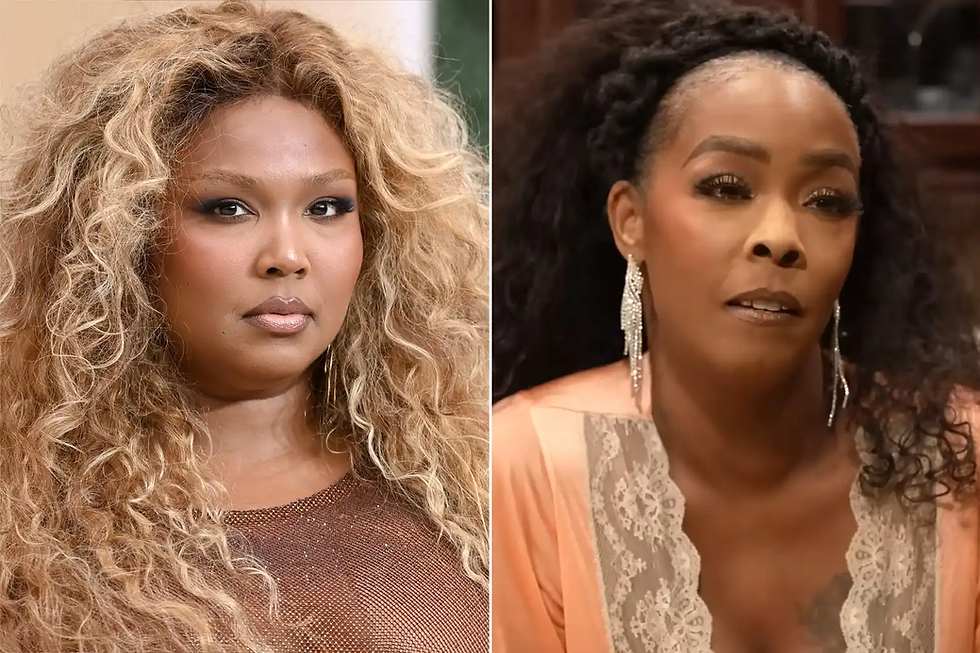
Lizzo is doing her best. Following an underwhelming performance of her latest album Bitch, which did not chart at all on the Billboard 200 despite its predecessor Special debuting at #2 with 69,000 album-equivalent units, the "About Damn Time" singer is making the best of a disappointing situation. In a new interview — the first episode of Zachary Hourihane aka the Swiftologist's new podcast Proto Pop — she dives into how she's doing following Bitch's release and the world perceiving her as a flop.
via: EW
Following news that her own new album Bitch drastically underperformed on the charts upon its recent release, Grammy-winning pop star Lizzo has spoken out against the "Khia Asylum" meme often used on social media to describe "flopping" female musicians.
In a new interview with social media personality Zachary Hourihane (also known as the Swiftologist), the 38-year-old "Truth Hurts" performer responded to a question about the state of her career and the "obsessive focus on them flopping that women get" when new releases don't reach the success of past output.
“Even that is backhanded in itself, to name it after this extremely phenomenal… this extremely talented incredible pillar in the Black community and in Black rap music," Lizzo said as part of her lengthy answer on the topic, referencing the titular Khia Asylum artist, Khia, whose 2002 hit "My Neck, My Back (Lick It)" remains an iconic anthem in pop culture.
Lizzo called the term a "weapon that targets only women, and a lot of Black women. Let’s be real," before labeling it "a little strange" when people take the phrase too seriously outside of its comical meme origins.

"I think it’s just funny for people, and I think it should remain funny, it should remain a meme," Lizzo explained. "Now it’s evolved to a thing where somebody could be the most successful artist last year, and now they’re back in the Khia Asylum?"
She described it as a "nebulous" descriptor, and criticized it as "a tool to bully artists and have power over them" that has devolved into "nonsense" through overuse.
She added that she "can’t be in the Khia Asylum" because she has "Grammys and world-record music," including her newly awarded Diamond record "Truth Hurts," which hit No. 1 on the Billboard Hot 100 and was recently certified 10-times Platinum by the Recording Industry Association of America.
"I am a successful artist," Lizzo stressed, calling herself "impervious" to being in the Khia Asylum at all, later quipping, "Save that for the one-hit wonders. No shade!"
Still, she admitted that she's "in the weeds" in terms of her current career, which saw her latest album, Bitch, fail to chart on the Billboard 200 upon moving 3,000 total units in its first week of release, and drop to a mere 650 units across the following frame, data tracking service Luminate previously confirmed to Entertainment Weekly.
Other artists have embraced the internet putting them into the Khia Asylum. Pop star Bebe Rexha shared a meme in January depicting a Grim Reaper-style figure coming to set her free from the institution, after other artists broke out of the Khia Asylum thanks to newfound success (including Tate McRae, Sabrina Carpenter, Charli XCX, and Zara Larsson).
"Guys please help me. It’s so lonely in here," Rexha joked, months before her new album, Dirty Blonde, hit No. 43 on the Billboard 200 albums chart.
In a New York Times interview last month, Lizzo previously addressed her standing with the public after a controversy saw backup dancers file a lawsuit against her (which was eventually partially dismissed) over alleged abuse and toxic workplace behavior (which Lizzo has strongly denied).
"Everything that I have shown the world is me. And I think that always puts someone in a vulnerable position. I think pop stars have built a sort of protection of themselves, and they put the pop star character in the front. And then the real them gets to sit in the back. I never did that because I came from the indie world," she told the publication. "This is who I am. I don’t have anything to hide. I love myself. And the world loved me back for it. I think that the beauty of everything is that I get to evolve as a person, and I get to have more depth as a person, because it isn’t always happy-go-lucky. And I feel like moving forward — it’s kind of hard to talk about."
Watch Lizzo's interview with Zachary Hourihane aka the Swiftologist below.
Comments