The Gworls Are Fighting: Older Queers Are Schooling Gen Z on Heated Rivalry

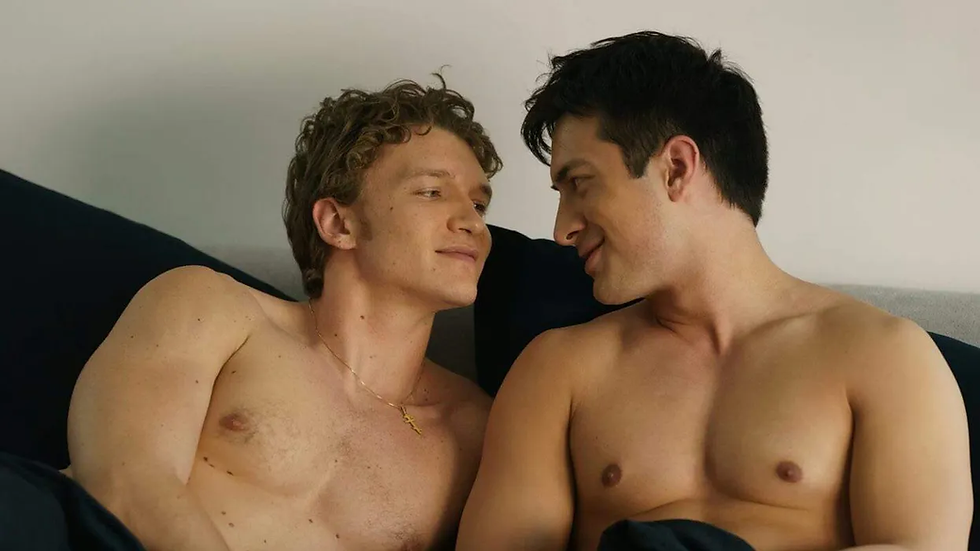
I get the appeal of "Heated Rivalry" and why it’s been plastered all over my social media feeds. The ambiguous sexuality of the two lead twunks, their butter-smooth skin, blade-sharp jawlines and sculpted abs nested neatly in our favorite homoerotic contact sport – hockey, that is – seem predestined for fan-fiction folders of smut-obsessed netizens.
via: Queerty
In a time not too long ago, coming out as gay could completely derail your life. In certain professions (and certain locations) it’s still the case. While we’ve come a very long way since the closeted days of the 1950s, we still haven’t come as far as we’d like to think. And in the spicy hit show Heated Rivalry—whose action opens in 2008—we get a glimpse at just how difficult things were for queer men in sports even in the not-so-long-ago past.
Both Ilya (Connor Storrie) and Shane (Hudson Williams) are closeted hockey players whose steamy affair threatens to completely upend their lives, but Gen Z fans of the show are questioning the pair’s choice to keep their sexuality under wraps.
“Gen Z does not understand the coming out experience,” says TikToker Sedona Violet in a video talking about the younger generation’s reaction to the show. “The way they’re just so confused about why Shane and Ilya and Scott wouldn’t be out in this modern day, and it’s like, it used to be a really f*cking big deal to come out.”
Even for millennials, she explains, most people waited until college or after to come out as queer for a number of reasons. “You could lose your family, your community, your career, you could literally lose your life by being outed.”
In 2008, queer representation in the mainstream was in its infancy, and you couldn’t find it just by turning on the TV. You had to look for it. Gay marriage wasn’t yet legalized, and in the sports world, it was assumed that if you wanted to keep your career, you’d keep your sexuality private. This remains the case even today in certain areas of the sports world.
“There are no gay out professional athletes in the NHL,” explains TikToker @thetwulk. “Does that mean they don’t exist? No. Does that mean they are not entitled to want connection, intimacy, sex, relationships, just like their heterosexual counterparts? No.”
“We’re starting the show 7 years before gay marriage was legalized in the United States,” another commenter wrote. “Pre 2015 was an entirely different world.”
“Kerr Smith’s career was ruined because of his kiss on Dawson’s Creek,” another viewer pointed out, referencing Smith’s turn as Jack, the one gay character on the popular 2000s soap. Not only that, but in 1998, the first year of the show’s run, out-gay college student Matthew Shepard was attacked and left for dead in Laramie, Wyoming. Anti-sodomy laws were still on the books in Texas, and in the fall, the murder of Boston trans woman Rita Hester led activist Gwendolyn Ann Smith to start the Transgender Day of Remembrance.
“I’m not that old,” wrote one commenter, “but I remember Matthew Shepard and the protests at his funeral, I remember Ellen’s Time cover and the backlash, I remember Oprah and Barbara Walters badgering celebrities in interviews, I remember [Grey’s Anatomy actor] TR Knight being outed by being called a slur by a costar on set… being comfortable coming out still isn’t simple.”
Not to mention the forced outings of celebrities by (gay) blogger Perez Hilton, the general media sh*tstorm that happened any time someone suggested that they weren’t unequivocally, completely, 100% straight.
“When Heated Rivalry started getting popular…I was upset,” says Gen Z TikToker Coach Jackie J, going on to explain that she was upset that the first explicit gay sports series had to feature men instead of women, “because men get everything.” But then, she realized something. “We have so many lesbians in our leagues, and what do the men have? As soon as I had that thought, I was like…what do the men have? The men don’t have anything!”
The world of professional men’s sports is still, compared with women’s sports, incredibly closeted. The Heated Rivalry craze—and the heated discourse around—isn’t just about people wanting a show that shows us the world we’d like to live in. It’s about finally having a show that’s honest about the pain of the past, while showing us a path forward through the dark moment we’re living in now. Maybe it’s not perfect, but it’s a step in the right direction.


Comments