Netflix’s ‘Reality Check: Inside America’s Next Top Model’: The 12 Most Shocking Revelations


We were rooting for you, Reality Check, we were all rooting for you!
But alas, Netflix‘s documentary about the rise and fall of America’s Next Top Model is a rather grueling and self-serious affair which attempts to turn the reality hit that ran for 24 seasons into a cultural war crime.
via: People
Netflix’s new docuseries Reality Check: Inside America’s Next Top Model takes viewers behind the catwalk to uncover what really went down on the Tyra Banks-created reality show, which aired for 24 seasons from 2003 to 2018. The three-part docuseries, which began streaming on Feb. 16, features unprecedented access to former judges, contestants and producers — as well as Banks herself, who spoke candidly about the show’s complicated legacy.
Top Model has come under fire in recent years for some questionable photo shoots — including using blackface in a challenge where contestants were made to portray races and ethnicities outside of their own — as well as allegations of body shaming and promoting unhealthy lifestyle choices among contestants. In the Netflix docuseries, Banks and the other America's Next Top Model personalities weighed in on those controversial moments, revealing everything from their reasonings to their regrets.
“I knew I went too far. It was very, very intense, but you guys were demanding it, so we kept pushing it, more and more and more,” Banks said in the trailer for Reality Check.
From the truth behind some of America's Next Top Model’s most memorable scenes to the future of the show, here are 11 of the most shocking bombshells revealed in Netflix’s Reality Check: Inside America’s Next Top Model.
01 of 12
America's Next Top Model was initially turned down by all the major networks

Banks first had the idea for America’s Next Top Model in 2002. According to the model, she wanted to create a show that not only gave a lens into the modeling world, but also challenged the beauty standards of the time.
“I want to marry American Idol and The Real World and set it in the modeling industry,” Banks said in the docuseries about the initial concept.
Banks approached television producer Ken Mok, who was immediately on board. She also brought in runway coach J. Alexander (a.k.a. “Miss J”) and makeup artist Jay Manuel (a.k.a. “Mr. Jay”). With a “complete team,” according to Mok, they began pitching the show to the major networks — and were turned down repeatedly.
“We went to NBC. We went to ABC. We went to CBS. We went to Fox,” Mok recalled in the Netflix docuseries. “It was just a no,” Manuel added.
With multiple rejections, Banks and Mok went to their final stop: UPN (now The CW). At the time, UPN’s ratings were struggling and they were looking for a hit new show to boost their numbers. After hearing Banks’ Top Model pitch, they decided to take a chance and pick up the reality show.
“When you're at the very bottom of the mountain, you have nothing to lose,” Dawn Ostroff, the president of UPN at the time, said in Reality Check. “But if it did work, we had everything to gain.”
02 of 12
Shandi Sullivan claimed she was sexually assaulted while filming America's Next Top Model
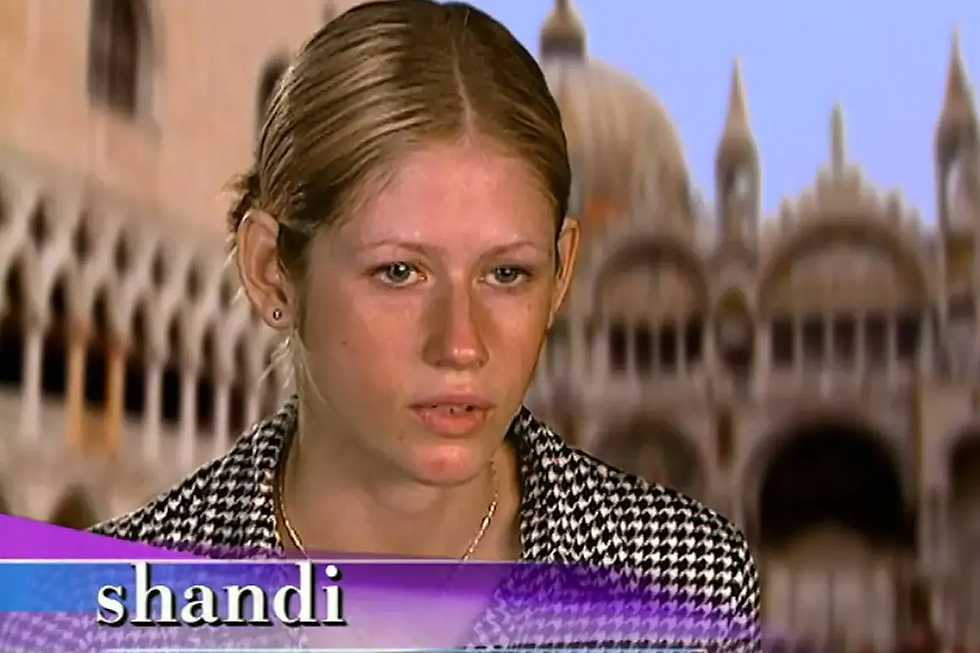
One of the most notorious scenes in America's Next Top Model history came in cycle 2 of the show, when the remaining five contestants went to Milan for go-sees and photo shoots. During the trip, one contestant — Shandi Sullivan, a former Walgreens employee from Kansas City, Mo., who was in a long-term relationship with her boyfriend, Eric — was filmed drunkenly having sex with a Vespa driver the models met during the day.
The scene was framed on the show as a cheating scandal, but in Reality Check, Sullivan painfully recalls the details of what she alleges was sexual assault. In her retelling of the events, Sullivan claims that she was intoxicated to the point of being “blacked out” — and that production kept filming as opposed to removing her from the situation.
“I was hammered. I think I had two bottles of wine by myself,” Sullivan claimed in Reality Check. “I was blacked out for a lot of it. I didn’t even feel sex happening, I just knew it was happening. And then, I passed out.”
When asked if she thought production should have stopped it, Sullivan responded, "I think they should have f---ing, like, been like, 'Alright, this has gone too far. We gotta, we got to pull her out of this.' ”
In the docuseries, Banks claimed she had no involvement in production and the editing of storylines, while Mok said that the contestants were all made aware that everything would be filmed — including "the good, the bad and everything in between."
He also stated that the full extent of what happened wasn't shown in the final cut. “I will tell you this. When I went into post and saw the footage, we scaled back that scene in a significant way,” Mok said in Reality Check.
“It’s important for people to know that we didn't put everything on TV,” Banks added.
03 of 12
Banks allegedly forced cycle 6 winner Danielle Evans to have the gap in her teeth closed against her wishes

America's Next Top Model was famous for its makeover episodes, where contestants would often receive shocking changes to their hair color and style. In cycle 6, two Top Model hopefuls, Joanie Sprague and Danielle "Dani" Evans, received extensive dental work as a part of their makeovers. However, Evans initially declined the procedure, which involved closing the gap between her two front teeth — until Banks allegedly threatened to send her home from the competition if she didn’t comply.
“That’s not your right to tell me what to do with my body,” Evans, who ultimately agreed to getting her gap closed, said in the Netflix docuseries. “It's my life and it was toyed with consciously. And me saying no, and them going against that — it’s invasive.”
Banks said she later apologized to Evans for pushing her to close the gap in her teeth, but stood by her reasoning for the decision.
“That was between a rock and a hard place for me,” Banks explained. “Because there were agents who would tell me, 'She will not work with those teeth. It’s just not going to happen.' "
Evans, however, had harsh words for Banks’ justification. “Bull f---ing s--t. Me getting my gap closed is not opening any doors for me,” she said. “You knew what you were doing for the show. You were making good TV at my expense.”
04 of 12
Some contestants developed eating disorders while competing on the show

Judges were often hyper-critical of contestants’ weight and figures, frequently “body shaming” the women, according to Sprague. This led some of the Top Model hopefuls to develop eating disorders while competing on the show.
“Were there eating disorders on the show? Yes, yes there were,” cycle 5’s Bre Scullark alleged in the docuseries. “You want to do anything you can to get to the next round.”
“It was very common to live on Diet Coke and cigarettes,” added Whitney Thompson, who became the first plus-size model to win the show in 2008. Thompson added that frequently, production did not provide clothes in her size for photo shoots, which felt "demeaning."
"I just pretended like it didn't bother me, but, and I'm sure most of the girls would do this, I would cry in the shower every day because the shower is the only place that the cameramen couldn't come, so that was your safe place to release and be like, 'Why are they doing this to me?' " she told PEOPLE in February 2026. "I knew that they were trying to poke me and get something out of me, so I just played it cool, like, 'That's fine. We'll just duct tape my dress. No worries.' "
Cycle 4’s Keenyah Hill was another contestant whose weight became a part of her storyline. Throughout her time on the series, she was selected to represent “gluttony” in a photo shoot about the seven deadly sins and to pose as an elephant in another challenge.
“I later found out that there are women who developed eating disorders from comparing themselves to what I was looking like and what the judges were saying,” Hill said. “I think there’s just some level of responsibility to the viewer, knowing there are so many young women watching this show. There's an insensitivity towards what it would do to their self-confidence.”
Banks, however, justified the conversations about weight as a sign of the times.
“When it comes to weight, back then the fashion industry's beauty standards were so narrow,” she said in the docuseries. “That’s the world that we lived in.”
05 of 12
Banks’ admitted she “went too far” when she yelled at cycle 4 contestant Tiffany Richardson

One of the most infamous scenes in America's Next Top Model history came in cycle 4, when Banks erupted on contestant Tiffany Richardson. After Richardson was eliminated, Banks felt like Richardson was dismissive about the lost opportunity and launched into a heated speech, screaming the memorable line, “We were rooting for you. We were all rooting for you!”
But now, in Reality Check, Banks admitted that that was the toughest moment for her in the entirety of the show — and that she “went too far” in yelling at Richardson.
“I lost it,” Banks said. “It was probably bigger than her. It was family, friends, society, Black girls, all the challenges we have. So many people saying that we’re not good enough. I think all of that was in that moment. That’s some Black girl stuff that goes real deep inside of me. But I knew I went too far.”
While the outburst has since become a viral moment, it was nothing to laugh about in real life, according to the former judges. “It was definitely the most difficult moment on set I had ever experienced,” Manuel said.
“There was a lot more that was really said and some of the things that were said were really not well intentioned,” he continued. “I will probably never repeat the lines that were actually said in that room that day ... People have tried to make it something funny, but it really wasn't."
Nole Marin, who was a judge during that cycle, added, “All I know is, the next week we had all the lawyers on set."
06 of 12
Tyra Banks Froze Out Jay Manuel After He Wanted to Leave Show

Manuel, who had been with America's Next Top Model since the beginning as the show's creative director, reached a crossroads after the conclusion of cycle 8 in 2007.
“The show had evolved in a way I'd never expected,” Manuel said. “I really struggled over some of the things that happened. And that was something that was slowly depleting me, chipping away at my soul. So, it was time to tell Tyra I wanted to leave the show.”
Manuel sent Banks an email expressing his desire to move on — and it was not well received. According to Manuel, she did not respond for three days — and when she finally did, she supposedly only wrote three words: “I am disappointed.”
“After that email exchange, all communication just stopped,” Manuel said. “It should have been the opportunity to have a heart-to-heart, but that did not happen.”
Manuel then went on a weeklong vacation to St. Lucia. While there, he was contacted by his attorney, who told him that the show was requesting he stay on cycle 9. Manuel reluctantly agreed.
“There was a warning that strikes the fear of God in you,” Manuel said. “You know, people talk about being blacklisted. Those words were not used, but I had suspected that that's what it would turn into.”
Manuel ultimately remained on the show until cycle 18. Following that season, The CW called for a major overhaul — and Manuel, Alexander and Nigel Barker were fired.
“When I wanted to leave, I wasn't afforded that,” Manuel claimed. “And then I work on the show from cycles 10 through 18. I made so many concessions. That's the part that's the most hurtful.”
07 of 12
Production would, at times, purposely not select a model’s best photo

During the judging panel, Banks would present each model’s best photo from that week’s photo shoot to be evaluated by the judges. However, sometimes a model’s best shot was not chosen for storyline purposes, according to former contestants and judges alike.
“Before it is a modeling show, it is a television show,” Scullark said. “Personality beat out pictures.”
“There were definitely photos selected that we felt, we were like, wait what? That makes no sense," Manuel said. “Ken and his team and Tyra, they knew what they were doing ... sometimes, not always, it was not her best shot. There was a better shot."
On the flip side, Manuel was also encouraged to try and get better photos out of models who were struggling in the shoots, but whom producers wanted to remain in the competition for a storyline.
“I would sometimes be pulled aside and [producers would] say ... ‘We need them to go forward at least a couple of more episodes. Get us there,’” Manuel said. “Because if the photos are just crappy, it will become hard to say this person deserves to stay in the competition.”
08 of 12
When models were eliminated, they didn’t actually go home

When a model was no longer in the running to become America’s Next Top Model, cameras would follow as they left the panel of judges, said goodbye to the remaining contestants and packed their bags. Then, they would leave the model apartment — except they weren’t going home at all. Instead, a production assistant would escort the eliminated model to a hotel room, where they would remain until filming concluded.
“You don’t go home,” Hill shared in the docuseries. “Everyone stays with the production until the very end for confidentiality reasons.”
While staying in the hotel, the eliminated models were also not allowed to contact anyone.
“There wasn't a phone available to call anybody at that time,” cycle 8’s Dionne Walters said. “And then, of course, even if I did I would not have been able to tell them ... I couldn't disclose that information.”
09 of 12
The stigma of America's Next Top Model prevented some winners from getting modeling work

Winning America's Next Top Model came with the promise of a modeling career, sparked by contracts with CoverGirl and a top modeling agency. But beyond those two prizes, winners often struggled to get modeling work after the show, according to former contestants.
“I remember my first show season, I didn't book any shows,” Evans said. “What I was told was that no one wanted to book me for their shows because I was viewed as, like, this reality show star and designers didn't want me walking in the show to take attention, if you will, off of their collection and onto myself.”
Evans recalls an interaction in which one of her roommates, Chanel Iman, inquired with their agency as to why Evans wasn’t being sent on castings like the other models. The agent allegedly told Iman that Evans was treated differently “because she came from Top Model."
“That was a hard, hard pill to swallow,” Evans said.
Evans also alleged that Banks admitted to her that she knew participating in America's Next Top Model came with a stigma in the modeling industry.
“They built a whole empire, a multimillion dollar brand known as America's Next Top Model off the backs of every girl's dream that ever did that show,” Evans said. “And it never became realized.”
10 of 12
Alexander had a stroke in 2022 that left him in a coma and unable to walk or talk

Alexander, the iconic runway coach who served as a judge on America's Next Top Model, suffered a stroke on Dec. 27, 2022, he revealed in the Netflix docuseries. Following the stroke, he was in a coma for five weeks — and when he regained consciousness, he was unable to walk or talk.
Miss J has since regained the ability to speak, but has yet to walk since his stroke. However, the catwalker extraordinaire is “determined” to make it happen.
“I miss being the queen of the runway. I'm the person that taught models how to walk,” he said. “I taught models how to walk. And now, I can’t walk — not yet. Not yet. I'm determined to walk.”
While recovering in the hospital, Alexander was visited by his former fellow Top Model judges Barker and Manuel. “I don’t know whether he even wanted me to see him in that way; I was going to see him,” Barker said. “And that was just such a terrible shock and really upsetting and horrifying and scary.”
However, Banks has not visited Alexander since his stroke. “She just sent me a text that she wants to come and visit me,” Alexander said. “But no, not yet.”
11 of 12
Regretting Those Race Swapping, Crime Scene Shoots

The team expressed regret over some of the show’s most notorious model shoot concepts. It’s jaw-dropping that after doing a clearly ill-advised shoot where models used makeup to “change their race,” the show did it a second time a few cycles later. “This was my way of showing the world that brown and black was beautiful,” Banks explains. “Then we put it out there and the world is like, ‘Are you crazy? Have you lost your mind?’ Looking at the show now through a 20/20 lens, it’s an issue and I understand 100 percent why.”
Another session, where models posed as murdered crime scene victims, has executive producer Ken Mok making a rare mea culpa: “I take full responsibility for that shoot. That was a mistake. I look back now and think it was a celebration of violence. It was crazy. That one, I look back and I’m like, ‘You were an idiot.'”
11 of 12
Banks revealed America's Next Top Model would be returning for a cycle 25

In a shocking move, Banks was replaced as the host of America’s Next Top Model after cycle 22. The show aired for two more seasons with Rita Ora as its host before being canceled after cycle 24 in the spring of 2018.
Since leaving America's Next Top Model, Banks moved to Sydney, where she runs an ice cream shop called SMiZE and Dream. But in Reality Check, she reveals that America's Next Top Model would be returning — nearly eight years after its last cycle aired.
“I feel like my work is not done,” Banks said at the conclusion of the docuseries. “You have no idea what we have planned for cycle 25.”
If you or someone you know is struggling with an eating disorder, The Alliance for Eating Disorders provides a fully-staffed helpline at 1-866-662-1235, as well as free, therapist-led support groups.
If you or someone you know has been sexually assaulted, please contact the National Sexual Assault Hotline at 1-800-656-HOPE (4673) or go to rainn.org.


Comments